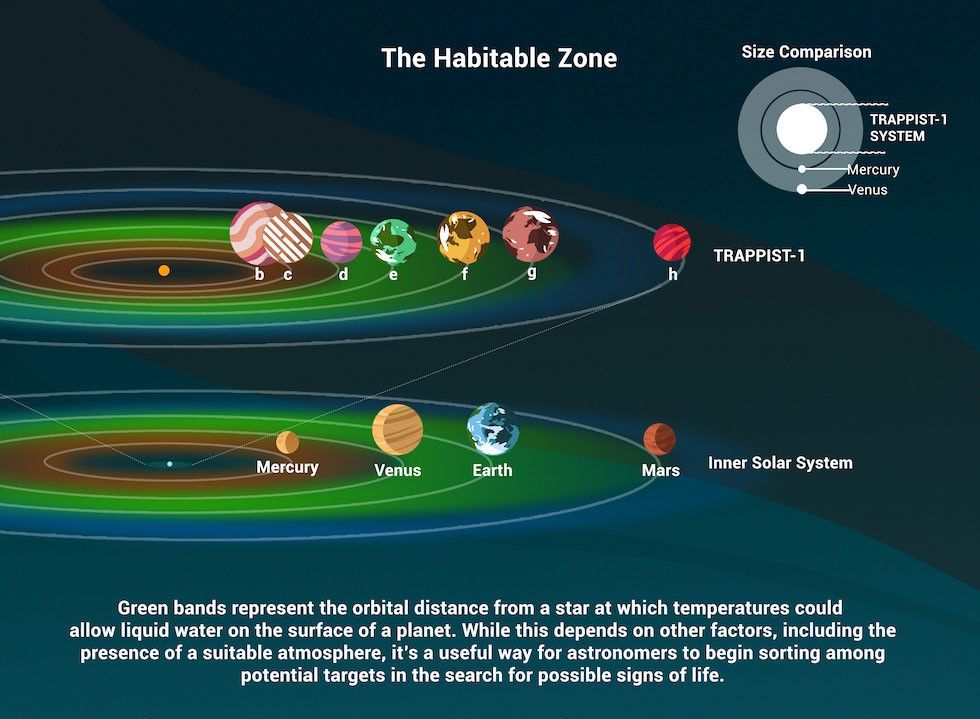
The “Habitable Zone” is a concept central to our search for extraterrestrial life – but it is not widely appreciated that it is only valid to planets with the same three dominant climate feedbacks as Earth. Would planets with climate feedback configurations somewhat different still have stable habitable climates?
Or does Earth’s climate feedback configuration make it a rare exception?
Congratulations to Chaucer Langbert on this excellent study that explores this important question!
The paper led by Chaucer has just been accepted in the Planetary Science Journal.

2020; Abbot 2016; Koll & Cronin 2018). Each bar represents the feedback parameter in W m−2 K−1, estimated from Earth
system model assessments and paleoclimate constraints. The upper axis shows the approximate feedback strength associated
with a 50 K climate perturbation, representative of transitions between major states (e.g., snowball to temperate). Feedbacks
are sorted by magnitude. Negative values (blue) represent stabilizing feedbacks that damp temperature changes, while positive
values (orange) indicate destabilizing feedbacks that amplify them. From Langbert & Apai (2026).
Earth has dozens of climate feedbacks. Most exoplanet models that inform the HZ boundaries focus on the three strongest (ice-albedo, carbon-silicate, and long-wave radiation+water vapor) and neglects all the others. For Earth, this approach works very well and it is tempting to assume that the same three feedbacks with the same strengths are present in other rocky planets. But there is no strong reason why the processes that impact the strengths of these feedbacks (and the dozens of others) should be exactly the same on other worlds.

In our study, Chaucer ran tens of thousands of integrations of time-evolving energy balance models with Earth-based but more universal climate feedback configurations. Specifically, we assumed that fourth, non-negligible feedbacks are present and varied their strengths to explore how the climates would evolve.
The findings are exciting and surprising: We identified an impressive diversity of climate dynamics: fixed points, run-aways and out-of-bounds (not habitable), limit cycles (hot house-snowball like oscillations), and chaotic climates.

The surprise: I expected that a fourth feedback – whether positive or negative – will result in much more chaotic climates, making Earth-like stable climates rate. While the fourth feedbacks did lead to much more diverse climate outcomes, surprisingly many of the climates still remained habitable. Good news for exoplanet surveys!
Of course, these simulations are still simplistic and exploratory in nature; we do not have reliable understanding of the climate feedback configurations of rocky exoplanets. Still, our more universal approach is a valuable exercise, especially when most other approaches assume Earth-like feedback configurations, potentially greatly underestimating the kind of climate dynamics that we should expect as we explore potentially habitable planets in the Galaxy.
This study is part of our NASA ICAR Astrobiology project Alien Earths, in which we advance fundamental research in astronomy, planetary science, atmospheric and climate science, chemistry and material sciences and integrate the knowledge gained into a unique framework – Bioverse – to support mission architecture and trade studies for exoplanet missions and concepts like HWO, LIFE, PLATO, and Nautilus Space Observatory.