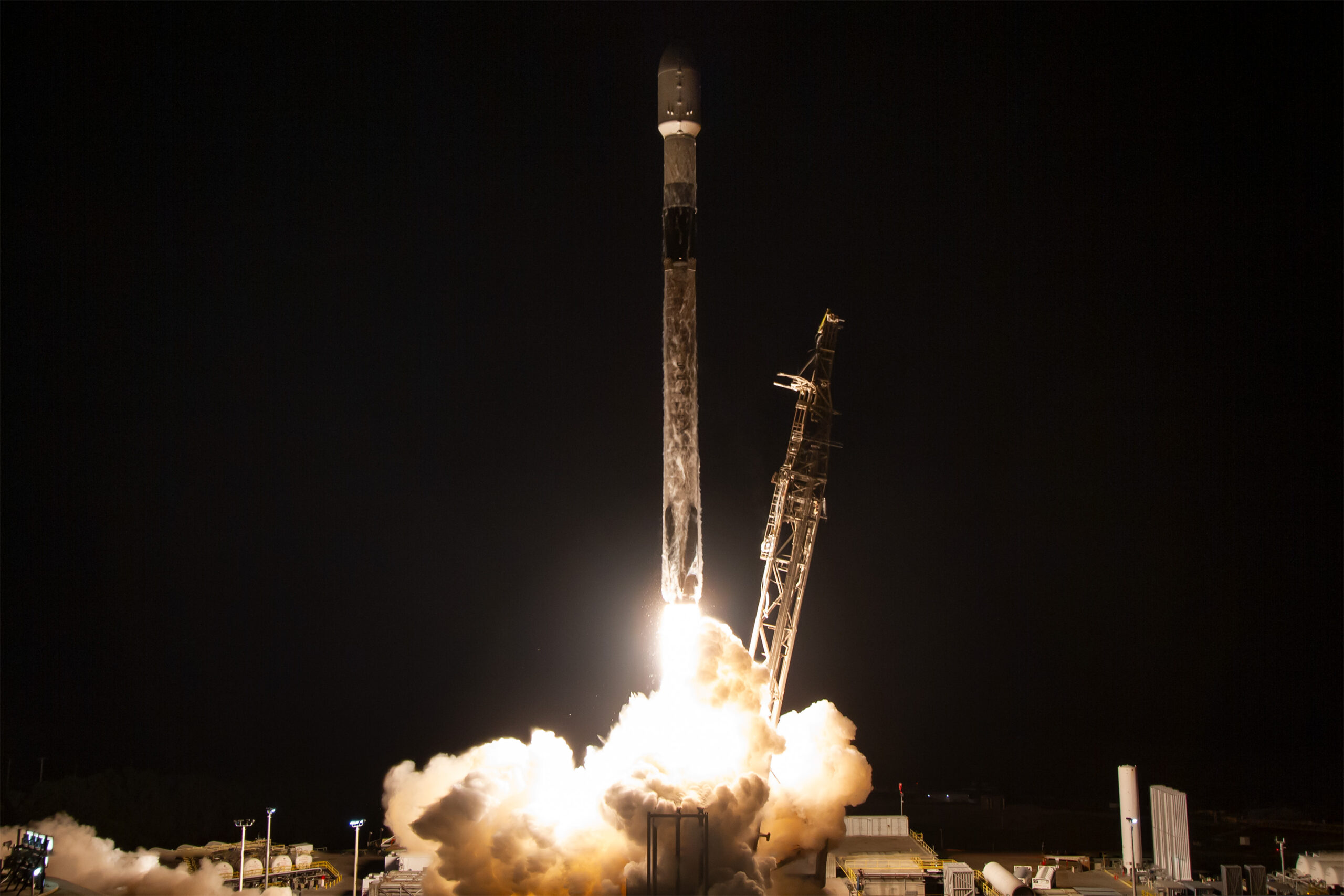
An incredible 24 hours! After a picture-perfect launch, Pandora is now in orbit, with solar panels deployed and alive (receiving commands from ground! After seven years of working on this project, it is so rewarding to see an idea become an actual NASA space telescope, pushing the frontiers of our knowledge.
The launch from the Vandenberg Space Force Base was an incredible experience: Along with a smaller group of Pandora, SPARCS, and BlackCat team members, we watched the launch countdown from control rooms. There was a slight delay for in-orbit collisional avoidance.

The actual launch? How did it feel?
We stepped out in the cold California pre-dawn, and watch the horizon light up. First, no sound, just the bright light, intense, like a small Sun just ignited. Then, the sound of the Merlin engines reaches us and we can hear the poweful rumble of the turbulent combustion of kerosene and liquid oxygen. The scintillating light, an inverted candle, rises: First, seemingly slowly, but accelerating fast. The powerful rumble continues, but what we hear happened seconds earlier, as by now the rocket is far. The rocket leans, the trajectory curves. The rocket’s light slowly fades as the engines turn away from us. All around me, a mix of emotions: cheers, laughter, applause. Someone is crying. The rocket fades, becomes a star moving among stars, bringing hopes and dreams with it. It still has more hard work to do: Finding its way to the right orbit, deploying its precious cargo safely. It is quite in the cold, and we wait. We know, that by now, the booster rockets separated and are in free fall. With their engines off, they are silent and invisible in the crisp and dark night. We know they are coming, but still surprised by the sudden light of the simultaneous ignition of two rockets, seemingly too close to us for comfort. This time, with the rockets crossing the speed of sound so close to us, a powerful twin sonic boom follows almost immediately. You can feel the sound waves; they go around you and through you. They scare people but gone in an instant. It is a good scare: The rockets on the pad. Cheers, applauses, screams erupt. People hug and shake hands; members of different teams, moved by the shared experience, congratulate. Some just stand, still processing what they felt.

It is cold – time to go in. We watch the next phases on the SpaceX live stream, just like millions around the world. Our families, our friends, our colleagues, who joined us in spirit for these few intense minutes.
We are waiting again. The SpaceX rocket passes through many steps – all critical – smoothly, on time. Feels routine. It gives us hope, but everybody is tense. We watch on the screen as the Falcon 9 deploys its first batch of satellites in a stunningly rapid sequence. A calm, professional voice identifies the satellites as they detach and drift away from the payload fairing. We enjoy perfect views of this from the NASA building. We wait again, for more then an hour, as the rocket ignites its engines again and brings the three NASA missions and other satellites to a higher orbit. More risks. The orbit is reached, the rocket is ready to deploy: Satellites sliding out in rapid succession. NASA and PSU’s BlackCat deploys. We are happy, applauses and screams. ASU’s SPARCS deploys and the room erupts in applauses. A large satellite deploys, finally revealing our Pandora, still in the payload fairing. One of the last satellites to deploy, almost alone in the fairing. Behind it, the southern coast of Africa. We hear the confirmation “Pandora deployed” before we see it move. A second later, Pandora is free and gently drifts into space. Our last close-in view. The room erupts again, cheers in the room, relieved smiles, laughter. Tears.
Now, 24 hours after launch, we know that Pandora is in safely on orbit, power positive (charging it batteries), and communicating with the group. Following the launch, our colleagues in Blue Canyon Technologies in Boulder, CO, and the University of The University of Arizona‘s Mission Operations Center worked very hard to rapidly connect to the satellite to gain control. This was a critical step: and it succeeded.
What’s next? Thorough in-space testing and commissioning, functional tests, calibrations will follow, for about a month. Today, we are meeting with the Pandora Science Team at IPAC, Caltech, to review launch and the science plan. I could not be more excited about starting a new phase in this amazing journey!
It has been incredibly rewarding to be part of the Pandora project. Hundreds of people throughout the country (and beyond) worked on getting us to this point. Pandora is one of those hard things: A small mission to address big questions. It has been a pleasure and privilege to be part of this adventure.
Looking ahead, with data coming in, we will ramp up science operations and look at the combination of Pandora, JWST, and other datasets to as fully study exoplanet atmospheres and their host stars as possible. For me, Pandora is a strategically critical step: Studying a very large number of small planets can be possible if we are confident that we can understand and remove stellar noise from the data. Pandora is our chance and such, it can set us on a path toward a deeper understanding of habitable worlds beyond our own.