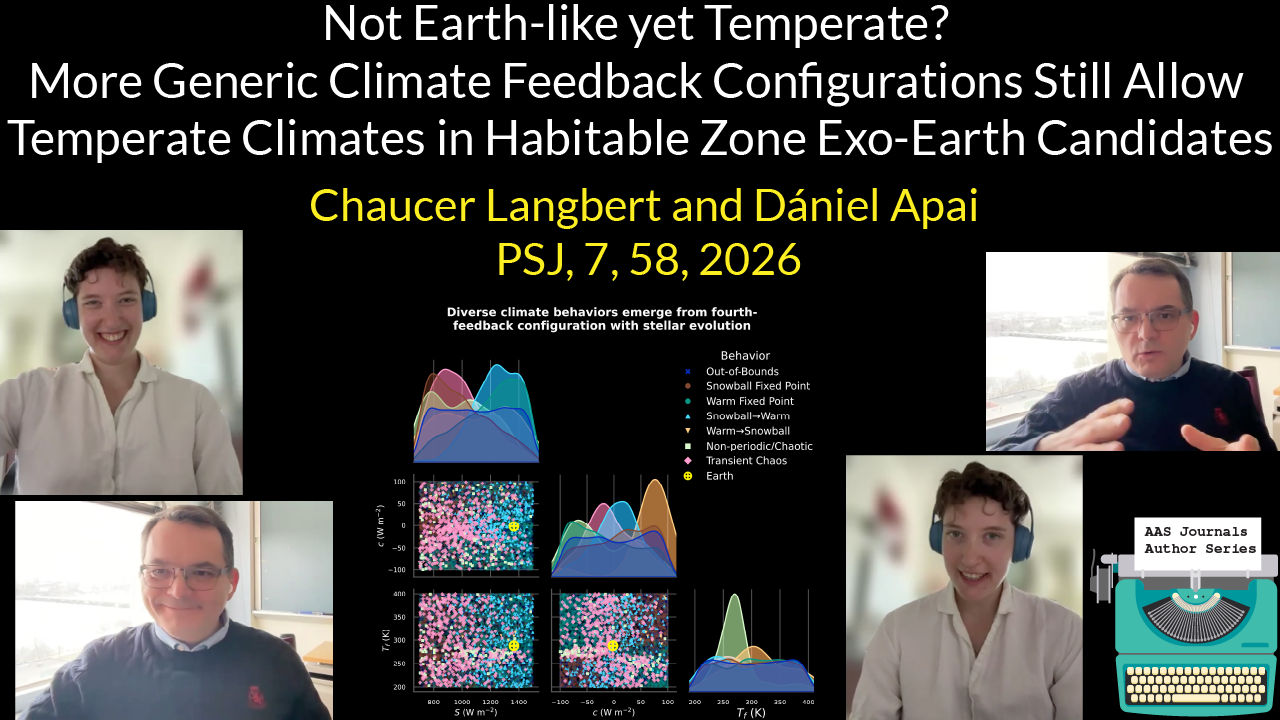
It was great to join LPL graduate student Chaucer Langbert and Frank Timmes to chat about our recent study looking into climate evolution and climate chaos for planets that have climate feedbacks different from Earth. Through 20,000 simulations, we explored the potential climate diversity of other worlds, with the goal of informing next-generation exoplanet surveys about the range of climates we should expect.
Watch the YouTube video for a nice summary of our study.
In our study published in the AAS‘ Planetary Science Journal , we simulated the evolution of habitable planet climates — assuming that their climate feedbacks are just a bit more complex than Earth’s.
The “Habitable Zone” concept is central to our search for extraterrestrial life – but it is often forgotten that it’s valid only to planets with the same three dominant climate feedbacks as Earth.

Would planets with climate feedback configurations somewhat different still have stable habitable climates?
Or does Earth’s climate feedback configuration make it a rare exception?
Earth has dozens of climate feedbacks. Most exoplanet models that inform the HZ boundaries focus on the three strongest (ice-albedo, carbon-silicate, and long-wave radiation+water vapor) and neglects all the others. For Earth, this approach works very well and it is tempting to assume that the same three feedbacks with the same strengths are present in other rocky planets. But there is no strong reason why the processes that impact the strengths of these feedbacks (and the dozens of others) should be exactly the same on other worlds.

In this study, Chaucer ran tens of thousands of integrations of time-evolving energy balance models with Earth-based but more universal climate feedback configurations. Specifically, we assumed that fourth, non-negligible feedbacks are present and varied their strengths to explore how the climates would evolve.
The findings are exciting and surprising: We identified an impressive diversity of climate dynamics: fixed points, run-aways and out-of-bounds (not habitable), limit cycles (hot house-snowball like oscillations), and chaotic climates.
The surprise: I expected that a fourth feedback – whether positive or negative – will result in much more chaotic climates, making Earth-like stable climates rate. While the fourth feedbacks did lead to much more diverse climate outcomes, surprisingly many of the climates still remained habitable. Good news for exoplanet surveys!
Of course, these simulations are still simplistic and exploratory in nature; we do not have reliable understanding of the climate feedback configurations of rocky exoplanets. Still, our more universal approach is a valuable exercise, especially when most other approaches assume Earth-like feedback configurations, potentially greatly underestimating the kind of climate dynamics that we should expect as we explore potentially habitable planets in the Galaxy.
This study is part of our NASA ICAR Astrobiology project Alien Earths, in which we advance fundamental research in astronomy, planetary science, atmospheric and climate science, chemistry and material sciences and integrate the knowledge gained into a unique framework – Bioverse – to support mission architecture and trade studies for exoplanet missions and concepts like HWO, LIFE, PLATO, and Nautilus Space Observatory.